


Airstone HB, HVF, PMC series power consumption comparison
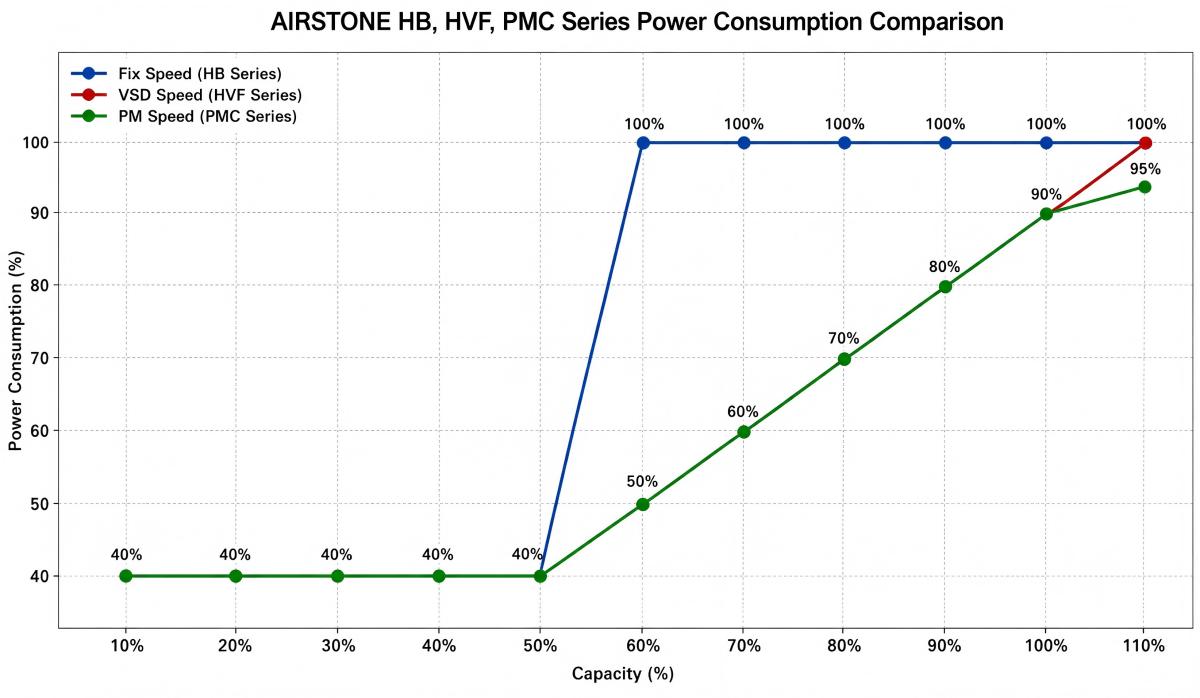
Chart Interpretation
Fixed-Speed Compressor (Blue Line)
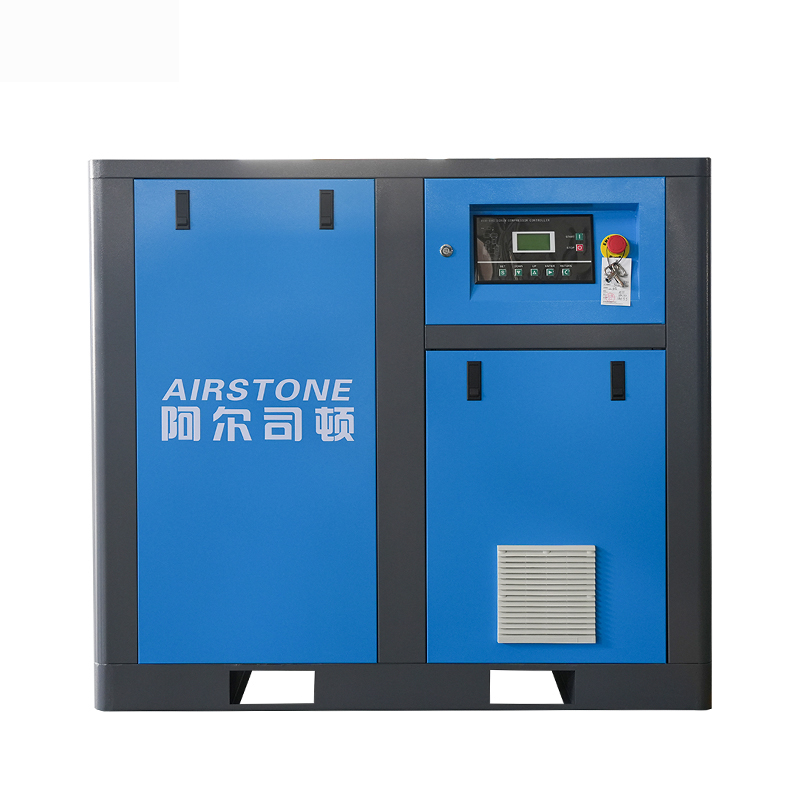
At load rates ≤ 40%, power consumption remains at 40% (unloaded standby state).
At load rates ≥ 60%, power consumption jumps directly to 100% and stays there.
Drawback: Frequent loading/unloading under fluctuating loads causes significant energy waste, especially in the 50%–70% load range, where its energy performance is the worst.
Standard VSD Compressor (Red Line)
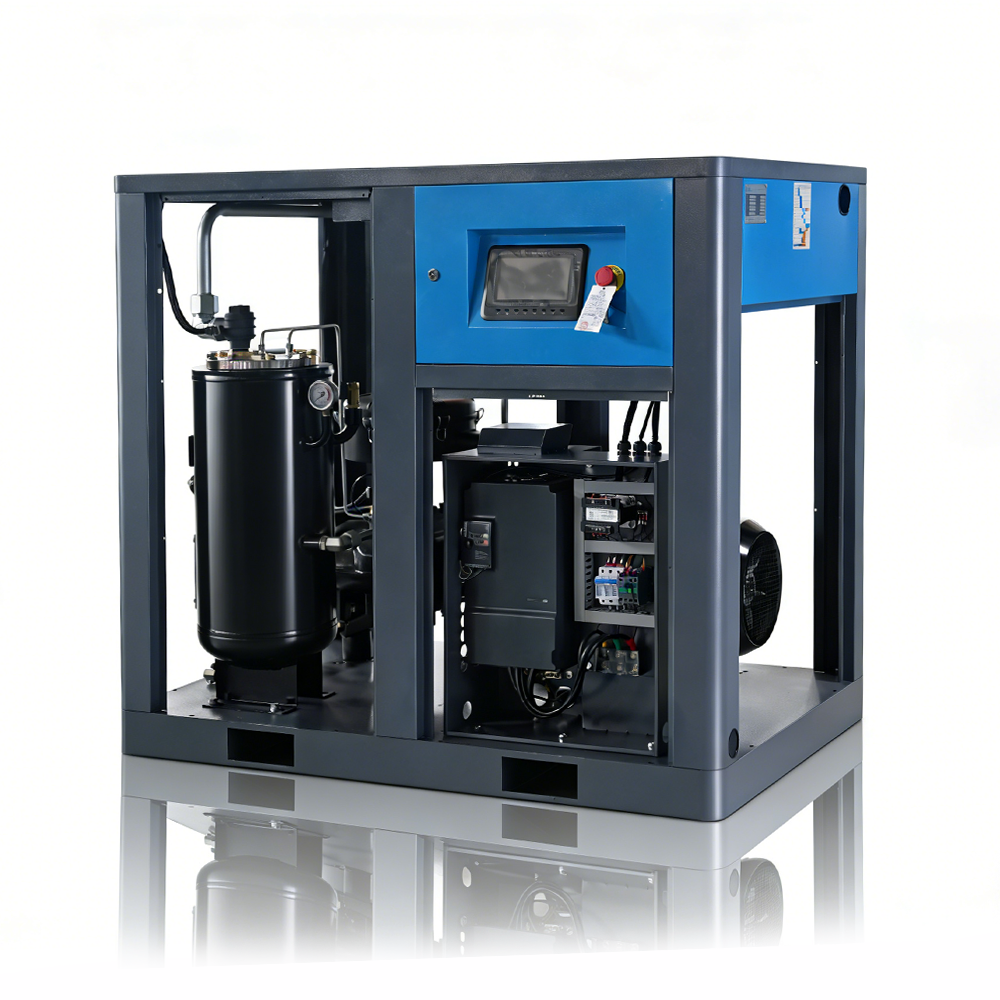
At load rates ≤ 40%, power consumption also stays at 40%.
At load rates ≥ 50%, power consumption rises linearly with the load, increasing by 10% for every 10% increase in load rate.
Advantage: Compared to the fixed-speed model, it achieves substantial energy savings in the mid-to-high load range (50%–90%).
PM VSD Compressor (Green Line)
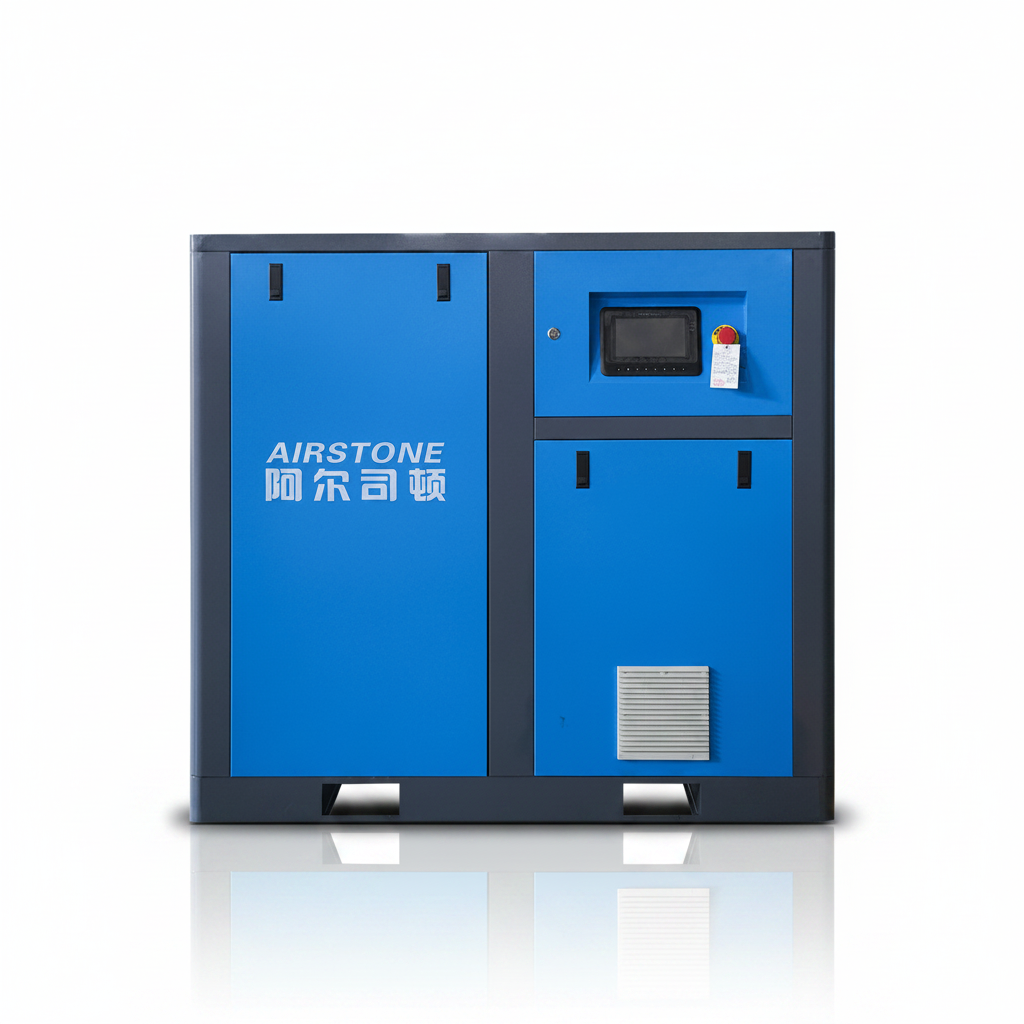
At load rates ≤ 40%, power consumption remains at 40%.
At load rates ≥ 50%, the trend mirrors the standard VSD model. However, at 110% load, its power consumption is only 95% (vs. 100% for the standard VSD).
Key Advantage: It delivers the best performance across the entire load range, with particularly high efficiency at high loads. The permanent magnet motor itself is 5%–8% more efficient than a standard induction motor.
Key Conclusions
When the load rate is consistently below 60%, the PM VSD model offers the most significant energy savings, reducing consumption by 30%–40% compared to the fixed-speed model.
Even at a stable 90%–100% load rate, the PM VSD model still maintains a ~5% efficiency advantage over the standard VSD model.
The fixed-speed model is only suitable for scenarios with a stable 80%–100% load rate; otherwise, energy costs will rise sharply.
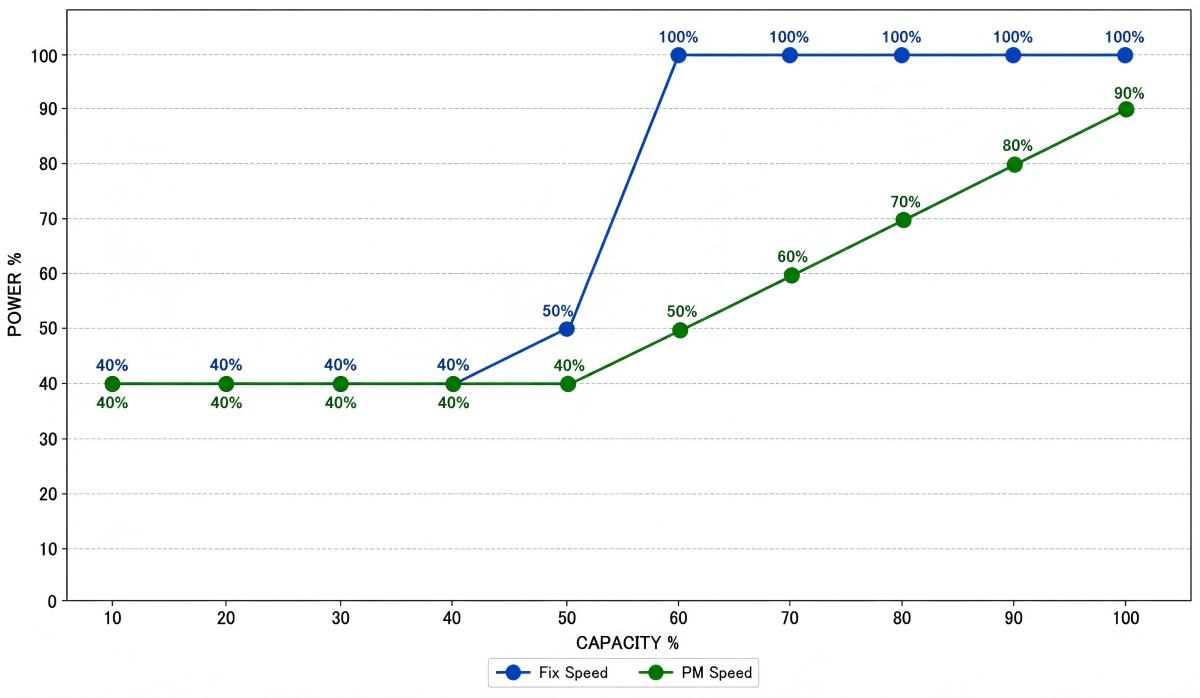
Chart Interpretation
Fixed-Speed Compressor (Blue Line)
At load rates ≤ 40%, power consumption remains at 40% (unloaded standby state).
At load rates ≥ 60%, power consumption jumps directly to 100% and stays there.
Drawback: Frequent loading/unloading under fluctuating loads causes significant energy waste, especially in the 50%–70% load range, where its energy performance is the worst.
Standard VSD Compressor (Red Line)
At load rates ≤ 40%, power consumption also stays at 40%.
At load rates ≥ 50%, power consumption rises linearly with the load, increasing by 10% for every 10% increase in load rate.
Advantage: Compared to the fixed-speed model, it achieves substantial energy savings in the mid-to-high load range (50%–90%).
PM VSD Compressor (Green Line)
At load rates ≤ 40%, power consumption remains at 40%.
At load rates ≥ 50%, the trend mirrors the standard VSD model. However, at 110% load, its power consumption is only 95% (vs. 100% for the standard VSD).
Key Advantage: It delivers the best performance across the entire load range, with particularly high efficiency at high loads. The permanent magnet motor itself is 5%–8% more efficient than a standard induction motor.
Key Conclusions
When the load rate is consistently below 60%, the PM VSD model offers the most significant energy savings, reducing consumption by 30%–40% compared to the fixed-speed model.
Even at a stable 90%–100% load rate, the PM VSD model still maintains a ~5% efficiency advantage over the standard VSD model.
The fixed-speed model is only suitable for scenarios with a stable 80%–100% load rate; otherwise, energy costs will rise sharply.

 8615015299001

 sales@airstone.net
  dgqianwei
 fg.cherry