


How to Select a Suitable Desiccant Air Dryer for Screw Air Compressors & Is a Desiccant Air Dryer Necessary?
Time:2026-05-29
Views:71
A desiccant air dryer is not mandatory for all screw air compressors. The selection depends primarily on the required pressure dew point of compressed air.
1. Is a Desiccant Air Dryer Necessary?
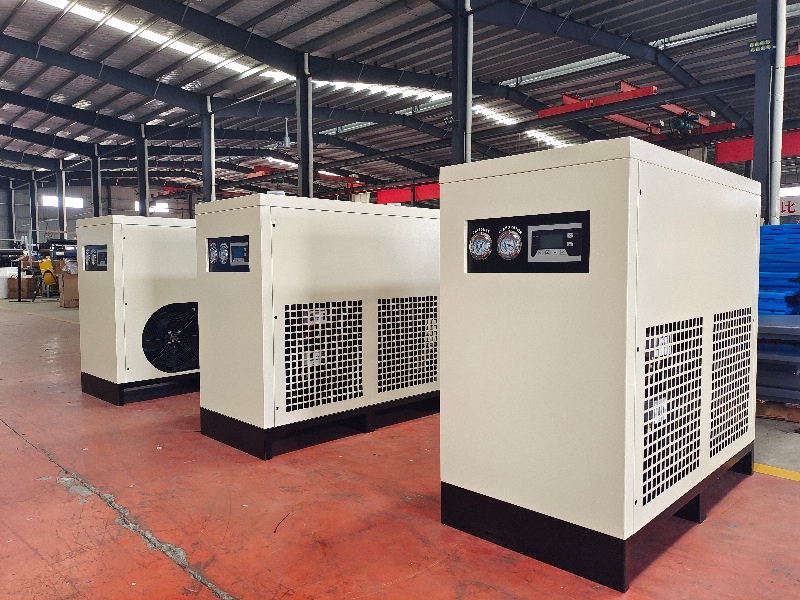
No Need (Refrigerated Air Dryer Is Sufficient)
Applicable to general pneumatic tools, conventional spraying, packaging machinery, and systems with no risk of pipeline icing.
- Required pressure dew point: 2 ~ 10 °C
Must Be Equipped with a Desiccant Air Dryer
- Scenarios with strict air quality requirements: precision spraying, electronics & semiconductor industry, food & pharmaceutical production, lithium battery manufacturing, precision instruments and meters.
- Required pressure dew point: -20 °C ~ -70 °C
- Outdoor pipelines in cold northern regions or pipelines operating below 0 °C (to prevent icing).
- Required pressure dew point: ≤ -40 °C
- Long-distance compressed air transmission without thermal insulation (to avoid condensed water and pipeline corrosion).
Summary
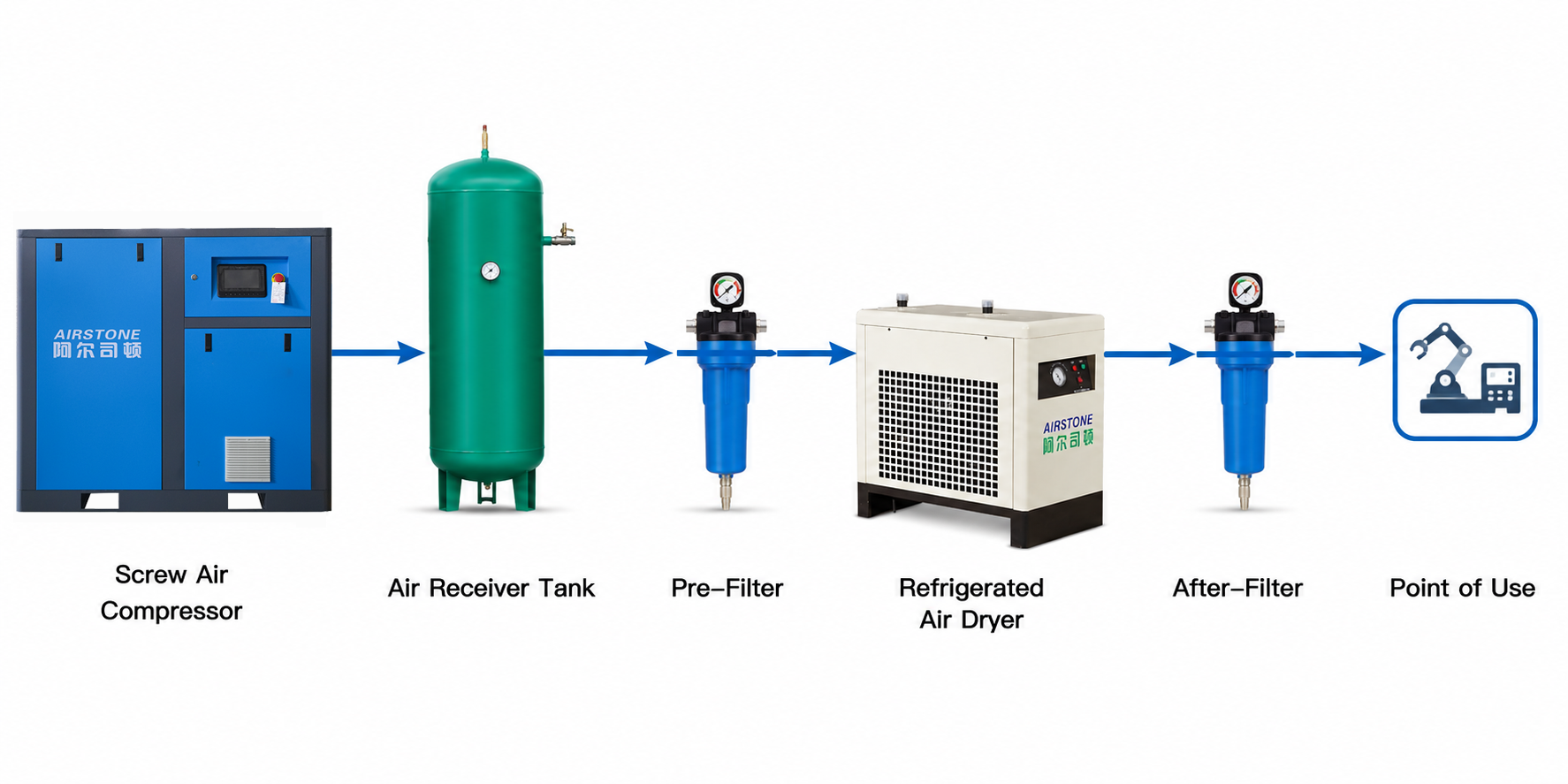
A refrigerated air dryer meets demands for standard industrial applications. A desiccant air dryer is only required for high-precision processes, low-temperature environments and applications needing ultra-dry compressed air.
2. Step-by-Step Selection Guide for Desiccant Air Dryers
2.1 Determine Pressure Dew Point (Select by Industry Requirements)
- ●-20 °C: General industrial applications & ordinary spraying → Choose heatless regenerative type.
- ●-40 °C: Automotive spraying & food packaging → Choose heated purge regenerative type (best cost-performance).
- ●-60 ~ -70 °C: Electronics, semiconductors, pharmaceutical sterile production & lithium battery industry → Choose heated purge / blower purge type with molecular sieve.
2.2 Match Air Flow Rate (Critical, Reserve Sufficient Capacity Margin)
- ●Formula: Rated flow of desiccant dryer = Compressor free air delivery × (1.2 ~ 1.5)
- ●Example: A screw compressor with an exhaust flow of 10 m³/min shall be matched with a desiccant dryer of 12 ~ 15 m³/min.
- ●For inlet air temperature above 45 °C or altitude over 1000 m: Adjust the multiplier to 1.3 ~ 1.5.
- ●For multiple compressors operating in parallel: Adopt one centralized large-capacity dryer for higher energy efficiency and easier maintenance instead of several small units.
2.3 Select Regeneration Mode (Based on Flow Rate & Energy Budget)
Heatless Regenerative Type (Flow rate ≤ 10 m³/min)
- ●Advantages: Simple structure, low procurement cost, no electric heating power consumption.
- ●Disadvantages: High purge air consumption (15% ~ 20% of total air flow for regeneration).
Heated Purge Regenerative Type (Flow rate: 10 ~ 50 m³/min, Recommended)
- ●Advantages: Low purge air consumption (5% ~ 8%), stable dew point, excellent overall cost-performance.
- ●Disadvantages: Requires a small amount of electric heating power.
Blower Purge / Compression Heat Regenerative Type (Flow rate ≥ 50 m³/min)
- ●Advantages: Nearly no purge air consumption; compression heat type reuses waste heat from air compressors.
- ●Disadvantages: Higher price and larger footprint.
2.4 Adapt to Inlet Operating Conditions (Prevent Malfunction)
- Inlet pressure: Standard range 0.7 ~ 1.0 MPa. Select special low-pressure models for pressure below 0.6 MPa, and customized high-pressure models for pressure above 1.3 MPa.
- Inlet air temperature: Standard requirement ≤ 45 °C. Install a pre-cooler if temperature exceeds 45 °C. The adsorption capacity will drop by about 15% for every 5 °C temperature rise.
- Inlet air oil content: Must be ≤ 0.1 ppm. Oil contamination will cause permanent failure of desiccants. A three-stage filter system (dust removal, oil removal, water removal) must be installed at the front end.
2.5 Select Desiccant Media (Matched with Dew Point)
- Activated Alumina: Suitable for dew point -20 ~ -40 °C. Features good wear resistance and economical cost, for general applications.
- Molecular Sieve: Suitable for dew point -60 ~ -70 °C. Superior water adsorption capacity and high precision, for high-precision working conditions.
- Silica Gel: Rarely used in industrial dryers; vulnerable to water impact, only for low-load operation.
3. Comparison: Refrigerated Air Dryer vs Desiccant Air Dryer
| Comparison Item | Refrigerated Air Dryer | Desiccant Air Dryer |
|---|---|---|
| Pressure Dew Point | 2 ~ 10 °C (General drying) | -20 ~ -70 °C (Deep drying) |
| Energy Consumption | Power consumption only, no air loss | Low power consumption, 5% ~ 20% purge air loss (heatless type) |
| Equipment Cost | Low (as baseline) | High (1.5 ~ 3 times of refrigerated type) |
| Maintenance | Simple (only filter replacement) | Desiccant replacement required (every 2 ~ 3 years) |
| Application Scenarios | General industrial workshops, cost-sensitive projects | Precision manufacturing, low-temperature environments, high-purity air requirements |
4. Recommended Configuration by Typical Applications
-
1.Ordinary factories (Pneumatic tools & general spraying) Screw air compressor + Refrigerated air dryer + Three-stage filters → Desiccant dryer is not required.
-
2.Automotive / high-end spraying & food packaging Screw air compressor + Refrigerated air dryer + -40 °C heated purge desiccant dryer + High-precision filters.
-
3.Electronics, semiconductors, sterile pharmaceutical production & lithium battery industry Screw air compressor + Pre-positioned refrigerated air dryer + -70 °C heated/blower purge desiccant dryer with molecular sieve + Activated carbon / sterile filters.
-
4.Outdoor pipelines / Winter operation in cold regions Screw air compressor + ≤ -40 °C heatless / heated purge desiccant dryer + Anti-freezing drain devices.
5. Common Selection Pitfalls & Reminders
- ●Do not pursue ultra-low dew point blindly: Models for -70 °C dew point cost 30% ~ 50% more than -40 °C models, with higher air consumption.
- ●Never omit front-end filters: Oil pollution leads to permanent desiccant failure and high subsequent maintenance costs.
- ●Prioritize the heated purge regenerative type: It balances dew point stability, energy consumption and equipment cost, and fits 80% of medium-to-high precision working conditions.

 8615015299001

 sales@airstone.net
  dgqianwei
 fg.cherry