


How to Select a Suitable Refrigerated Air Dryer for Screw Air Compressors
Time:2026-05-29
Views:67
The core principles for selecting a refrigerated air dryer are: reserve 10%–20% extra capacity based on airflow rate, match inlet air temperature and working pressure, meet dew point requirements, and choose the right cooling method. Final confirmation shall be made according to ambient conditions and energy consumption.
1. Matching Core Parameters (Mandatory Calculation)
1.1 Processing Airflow Rate (Most Critical)
Definition: Rated processing capacity under standard working conditions (0.7 MPa inlet pressure, 38°C inlet air temperature, 25°C ambient temperature), unit: Nm³/min.
- ●Formula: Rated airflow of refrigerated dryer = Exhaust volume of air compressor × (1.1 ~ 1.2)
- ●Example: A 10 m³/min air compressor shall be matched with a refrigerated dryer of 11–12 m³/min.
- ●For high temperature and high humidity environments, adopt a multiplier of 1.2–1.3.
Common mistake: One-to-one matching strictly according to the nameplate of the air compressor without extra capacity will lead to excessive moisture and unstable dew point during peak air consumption.
1.2 Inlet Air Temperature (Determine Dryer Type)
- ●Standard type: Inlet air temperature ≤ 45°C (screw compressors equipped with aftercoolers have an exhaust temperature of around 40°C).
- ●High-temperature type: Inlet air temperature 45–80°C (applicable to units without aftercoolers, poor heat dissipation in summer or long pipelines).
●Warning: A high-temperature type dryer or pre-aftercooler is a must if inlet air temperature exceeds 50°C; otherwise, the refrigeration system will overload and the dew point will rise sharply.
1.3 Working Pressure (Required Matching)
- ●Common operating range: 0.6–1.0 MPa (0.7–0.8 MPa for regular use).
- ●Pressure correction: Higher working pressure increases air density and reduces water content, which improves the actual processing capacity of the dryer.
- ●Low pressure (< 0.6 MPa): Select special low-pressure models.
- ●High pressure (> 1.3 MPa): Adopt customized high-pressure dryers.
1.4 Pressure Dew Point (Indicator of Drying Performance)
- ●Conventional range for refrigerated dryers: 2–10°C (atmospheric dew point approx. -5 ~ +5°C).
- ●General machinery & pneumatic tools: 10°C.
- ●Spraying & electronic assembly: 3–5°C.
- ●Precision instruments, food & pharmaceutical industries: Stable dew point at 2°C.
●Note: Select the minimum required dew point. A lower dew point means higher energy consumption.
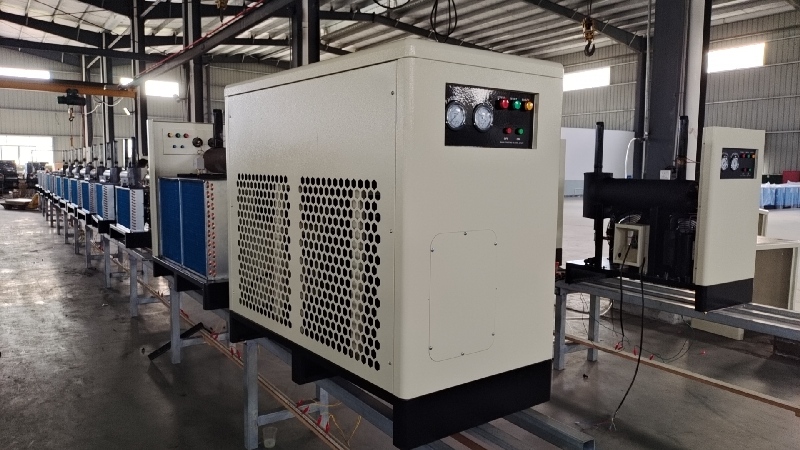
2. Selection of Cooling Methods (Air-Cooled / Water-Cooled)
2.1 Air-Cooled Type (Recommended for Most Scenarios)
- ●Application: Areas with insufficient water supply, no circulating cooling water system, or ambient temperature ≤ 38°C.
- ●Advantages: Easy installation, no water pipeline required, simple maintenance and low cost.
- ●Disadvantages: Performance drops when ambient temperature exceeds 38°C; relatively higher operating noise.
2.2 Water-Cooled Type (Preferred for High Temperature & Large Flow Rate)
- ●Application: Ambient temperature above 38°C, multiple air compressors in operation, large airflow rate (> 10 m³/min) or low noise requirements.
- ●Advantages: Stable heat dissipation, high working efficiency, low noise and steady dew point in summer.
- ●Disadvantages: Requires cooling water (temperature: 5–40°C, pressure: 0.2–0.7 MPa), complicated installation and additional maintenance costs.
3. Correction for Ambient Conditions & Operating Conditions
- ●Ambient temperature: Choose water-cooled models or upsize the capacity by one grade if ambient temperature > 38°C; take anti-freezing measures when temperature < 5°C.
- ●Altitude: Upsize the airflow capacity by 10%–20% for areas above 1000 meters above sea level due to thin air.
- ●Multiple compressors in parallel: One large centralized dryer is more energy-efficient and easier to maintain than multiple small dryers.
4. Quick Selection Procedures (Direct Application)
- ●Check the nameplate of the air compressor: exhaust volume (m³/min), working pressure (MPa) and exhaust temperature (°C).
- ●Calculate airflow rate: Multiply the exhaust volume by 1.1–1.2 to get the required rated airflow of the dryer.
- ●Confirm model type: Standard type for inlet air ≤ 45°C; high-temperature type for inlet air > 45°C.
- ●Select cooling mode: Air-cooled for water shortage and normal temperature; water-cooled for high temperature and large flow rate.
- ●Verify dew point: Select 2–10°C according to process requirements.
- ●Reserve extra capacity: Increase the airflow rate by another 10% for high temperature, high humidity or high-altitude environments.
5. Reference Matching Table (7–132 kW Screw Air Compressors)
| Compressor Power | Exhaust Volume (m³/min) | Recommended Dryer Flow (Nm³/min) | Common Cooling Mode |
|---|---|---|---|
| 7.5 kW | 1.1–1.3 | 1.5–1.8 | Air-cooled |
| 15 kW | 2.2–2.5 | 2.8–3.3 | Air-cooled |
| 37 kW | 5.5–6.2 | 7.0–7.5 | Air-cooled / Water-cooled |
| 75 kW | 10–12 | 13–15 | Water-cooled |
| 132 kW | 18–22 | 24–26 | Water-cooled |
6. Common Pitfalls to Avoid
- ●Do not pursue an excessively low dew point blindly: A dew point of 2°C consumes about 30% more energy than 10°C.
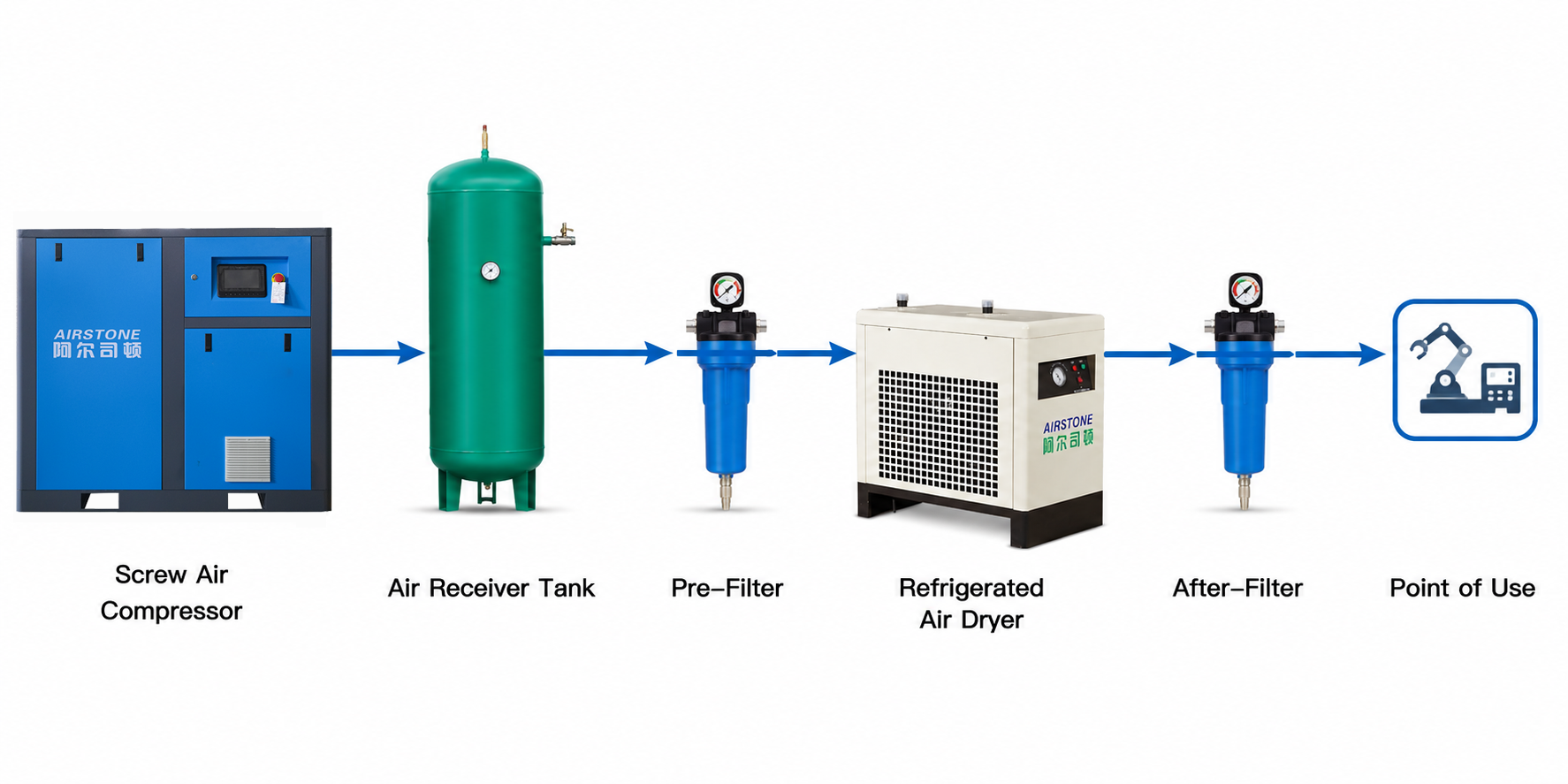
- ●Pay attention to post-processing filters: Install three-stage filters (dust removal, oil removal and water removal) in front of the dryer to extend service life and guarantee compressed air quality.
- ●Brand & after-sales service: Choose products with reliable refrigeration systems, automatic drain valves and easy maintenance. Avoid low-cost inferior units which are prone to frequent failures。

 8615015299001

 sales@airstone.net
  dgqianwei
 fg.cherry